Baruch Link Scholar-In-Residence 2026
February 12-14
Author of:
The Man Who Sold Air in the Holy Land
The House in Talbiya
SAVE THE DATE:
BOOK REVIEW (January 28 on Zoom) with Joel Grossman
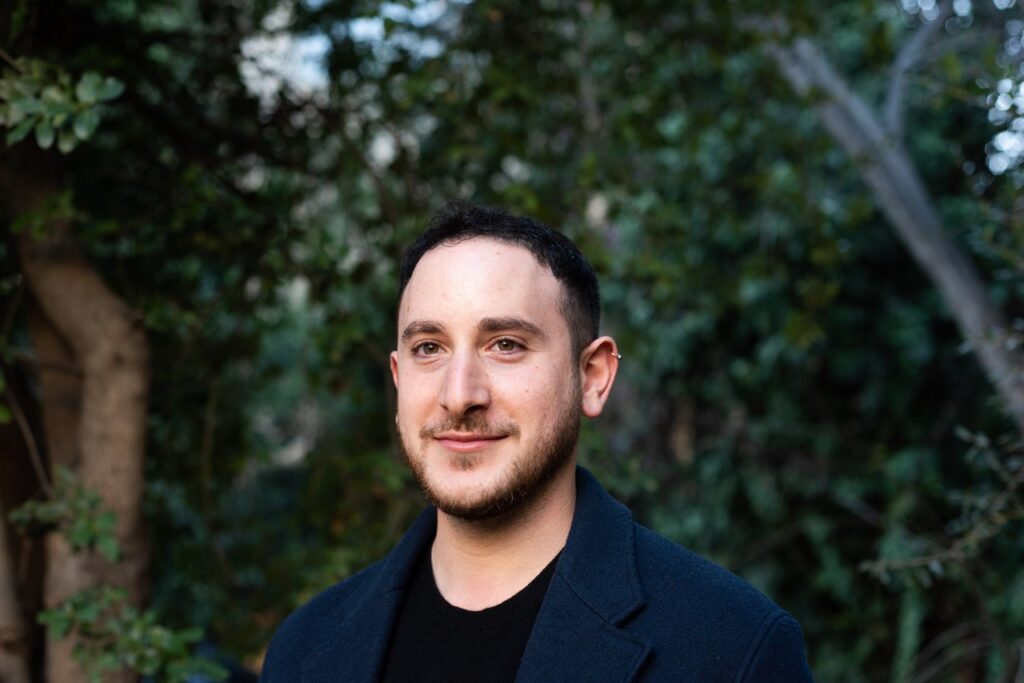
A Starworks Fellow in Fiction at New York University, Omer Friedlander is an award-winning writer. He is the author of the short story collection The Man Who Sold Air in the Holy Land (Random House, 2022). Friedlander has earned a BA in English Literature from the University of Cambridge, England, and an MFA from Boston University, where he was supported by the Saul Bellow Fellowship. He has also earned fellowships from Bread Loaf, Vermont Studio Center, Virginia Center for Creative Arts, and Blue Mountain Center. His new novel The House in Talbiya (2027) is a lyrical multigenerational novel about two families—one Israeli and one Palestinian—and the house that connects them.
Friedlander’s short stories have won numerous awards, including the Baltimore Review Winter Contest, Sonora Review Contest, Tom Howard / John H. Reid Contest, Moment Magazine’s Karma Foundation Fiction Prize. He has been a finalist for the Chicago Tribune’s Nelson Algren Award, the Writers’ Trust of Canada Royal Bank of Canada Bronwen Wallace Award, Lit Mag’s Virginia Woolf Award, the Lamar York Prize, Salamander Fiction Contest, and the Porter House Review Editor’s Prize, among others. His work has appeared or is forthcoming in the Chicago Tribune, One Story, and Granta. His stories have been published in many countries, including the United States, Canada, France, and Israel. The Man Who Sold Air in the Holy Land has also been published in the United Kingdom, and is forthcoming in other languages, including Italian, Dutch, and Turkish.
Omer Friedlander is the grandson of Saul Friedlander, the Pulitzer-prize winning Holocaust historian. He currently lives in New York City.
Dr. Baruch Link (1947-2019) was a beloved and distinguished scholar, teacher, poet and father who approached the study and transmission of Modern Hebrew literature with lifelong romantic devotion.
Born in Palestine in 1947 to liberal Zionist parents who both served during Israel’s War for Independence, Baruch was shaped by a childhood that developed in tandem with the nascent Jewish State. His worldview was formed by enduring years of regional conflict and warfare, as well as ensuing economic austerity, even as his home was filled with a dynamic and passionate exchange of ideas about the cultural revival of an ancient language and the politics of Jewish statehood and power. Baruch voraciously consumed the burgeoning new genre of Hebrew literature, then defined by an array of writers and poets including, S.Y. Agnon, Uri Zvi Greenberg, Hayim Nahman Bialik, Leah Goldberg and Zelda.
At 17, Baruch was on the verge of joining the Israel Defense Forces when he contracted a virus that irreversibly compromised his kidneys. Despite his pursuit of an official appeal, he was denied the opportunity to serve in the Israeli army which catalyzed his matriculation to academia. Baruch enrolled at Tel Aviv University, where he completed both a bachelor’s and master’s degree. During this time, he volunteered to teach active duty soldiers during several war periods and began to correspond with prominent Israeli writers which inspired his early poetry.
After completing his M.A., Baruch was accepted to a PhD program at the University of California Los Angeles (UCLA) where he would study under the tutelage of Professor Arnold Band, a world-renowned S.Y. Agnon scholar. Baruch received his PhD in comparative literature in 1976, turning his dissertation on Ezra Zussman, an early 20th century Hebrew poet, into the award-winning 1982 volume Studies in the Poetry of Ezra Zussman, published by Aleph. He followed that work with the poetry collection, Visions from the Hospital and Other Poems, also published by Aleph.
Baruch returned to Israel after completing his PhD with his new wife, Teri Cohan, a Los Angeles native and went on to teach in various seminars and at Israel’s elite colleges, including Tel Aviv University and Ben Gurion University. In 1985, Baruch and Teri had a son, Shmuel, born in Tel Aviv and later, a daughter, Tal, born in Los Angeles. The family returned to the United States in order for Baruch to attend a sabbatical at Harvard University before ultimately returning to L.A., where the family made their permanent home. There, Baruch taught at his alma mater, UCLA, the University of California San Diego and the University of Utah at Salt Lake City. He also held posts at the University of Judaism (now American Jewish University) and Hebrew Union College (HUC).
In Los Angeles, Baruch and his family joined Temple Beth Am and its lay-led “Library Minyan,” establishing themselves as committed and engaged members of the community. The Link children, Shmuel and Tal, attended the Pressman Academy Day School. It was this community along with family and lifelong friends from Israel and throughout the world who resolved to honor Baruch’s memory by forming and funding a Scholar in Residence weekend.
Baruch is remembered by those who knew him as a loving, tender and compassionate man; a brilliant teacher, scholar and poet; and a deeply committed yet questioning Jew. He was also an avid sports fan; devoted to the UCLA Bruins, the English Premier League team Manchester United and his “home” teams in Israel, Hapoel Ramat Gan (soccer) and Maccabi Tel Aviv (basketball). Despite a lifelong battle with illness, Baruch exuded joy and optimism. He was always reaching out to those who were ailing, lonely or grieving, his own struggle against suffering forever awakening him to the pain of others.
A successful kidney transplant in 2007 gifted Baruch with almost 13 additional years of teaching, writing and scholarly research, and most especially, being a family man. He was truly beloved by those fortunate enough to enter his orbit and blessed to see his son marry just before he passed away. Baruch’s first grandson was born in 2021 and named in Hebrew Ezra Baruch.
Co- Chairs: Teri Cohan Link, Ed Levine and Joel Grossman
Rabbi Rebecca Schatz, Associate Rabbi
Jacob Eisenstein, Program Director

Etgar Keret is a leading voice in Israeli literature and cinema. Keret’s books were published in fifty languages. His writing has been published in The New York Times, Le Monde, The New Yorker, The Guardian, and The Paris Review.
Keret lectures at Ben-Gurion University of the Negev as a Full professor. Over 100 short movies have been based on his stories, as well as feature films.
He has received the Book Publishers Association’s Platinum Prize several times, the St Petersburg Public Library’s Foreign Favorite Award (2010) and the Newman Prize (2012). In 2010, Keret was honored in France with the decoration of Chevalier de l’Ordre des Arts et des Lettres.
In 2007, Keret and Shira Geffen won the Cannes Film Festival’s “Camera d’Or” Award for their movie Jellyfish, and Best Director Award of the French Artists and Writers’ Guild. The two also co-wrote and directed “The Middleman” (2019), a French mini-series for ARTE. The series won the best screenplay award at La Rochelle fiction TV festival in France. Keret was the winner of the 2016 Charles Bronfman Prize. His collection “Fly Already” won the most prestigious literary award in Israel- the Sapir prize (2018) as well as the National Jewish Book Award of the Jewish Book Council. Keret’s new collection of stories “Autocorrect” was published this year.
Monday, October 14 at 7:00 PM on Zoom
Moderated by Joel Grossman
Released shortly before October 7, The Wolf Hunt tells the story of Lilach, an Israeli woman who moves with her family from Israel to Silicon Valley in hopes of raising her child in a safer environment. Her vision is shattered when there’s a terror attack at her local synagogue, and she soon suspects that her teenage son has committed a terrible crime.
Yaniv Iczkovits, born in 1975, is an award-winning author and screen writer. He has published four novels and one novella, and is now working on developing TV content based on his novels for Keshet and KI, Yes Studios, Endemol Shine and more.
His books include Pulse (Hakibbutz HaMeuchad), which won Haaretz’s debut novel prize and was translated into Italian; Adam and Sophie (HaSifriya HaHadasha), which won the Prime Minister’s Prize for Hebrew Writers; Laws of Succession, a novella published in the anthology “There’s a Story Behind the Money” (Achuzat Bayit). His third novel, The Slaughterman’s Daughter, was published by Keter in August 2015 and is translated into 18 languages worldwide. The book was awarded the Agnon Prize – in honor of Israel’s only Nobel Laureate for Literature – the first time the prize has been granted in ten years (2016).
Iczkovits won the Ramat Gan Prize (2017) for literary excellence and the People of the Book Foundation Prize (2017), and the British Wingate prize (2021). The Economist and The Sunday Times chose the book as one of the best books published in Britain in 2020, and The New York Times and Kirkus chose the book as one of the best books to look forward to in 2021 in the U.S. In January 2022 the book was announced as a finalist for the National Jewish Book Award.
In August 2020 Iczkovits published his recent book, Nobody Leaves Palo Alto (Keter) which immediately became a no.1 best seller in Israel, won critical acclaim, and is now translated to French (Gallimard) and Romanian (Humanitas Fiction). This book was also adapted to television by Iczkovits, and the TV series will premiere in Israel (Keshet) on November 2023.
Iczkovits studied at the Adi Lautman Interdisciplinary Program for Outstanding Students at Tel Aviv University, and during his Master’s degree he spent a year at Oxford University as a Chevening scholar from the British Council. His doctoral dissertation dealt with Ludwig Wittgenstein’s thought and analyzed the interplay between ethics and language. He taught for eight years at the University of Tel Aviv, and After receiving his Ph.D., he went on to pursue postdoctoral research at Columbia University in New York, where he adapted his doctoral dissertation into the book Wittgenstein’s Ethical Thought (Palgrave Macmillan 2012).
He currently lives in Tel Aviv with his wife and three daughters.
Tuesday, September 19 at 7:30 PM on Zoom
Moderated by Joel Grossman
You will love The Slaughterman’s Daughter! It is a rousing adventure story, with a myriad of memorable characters. It’s a funny, tragic tale that takes place in the shtetl world of Easten Europe in the 1890’s. The author is Yaniv Iczkovits, an Israeli writer with a great flair for drama and irony.
Dorit Rabinyan is the bestselling author of the acclaimed Persian Brides and Strand of a Thousand Pearls. She is the recipient of the Prime Minister’s Prize, the Itzhak Vinner Prize, the ACUM award and the Jewish Quarterly Wingate Award. All the Rivers was named as a book of the year by Ha’aretz and awarded the prestigious Bernstein Prize.
In 2016, after 15 years of silence, Rabinyan published All the Rivers (also known as Borderlife), which became the center of a political scandal in Israel. The momentous novel, sensitive in its details and enthralling at its peaks, was banned from use in high schools curriculum by Israel’s Ministry of Education. The book tells a story crisscrossed by physical and emotional borderlines and courageously marks the deceit in the separation between “you” and “I,” between “us” and “them.” All the Rivers spent more than a year as #1 bestseller in Israel, and has been translated into 17 languages.